
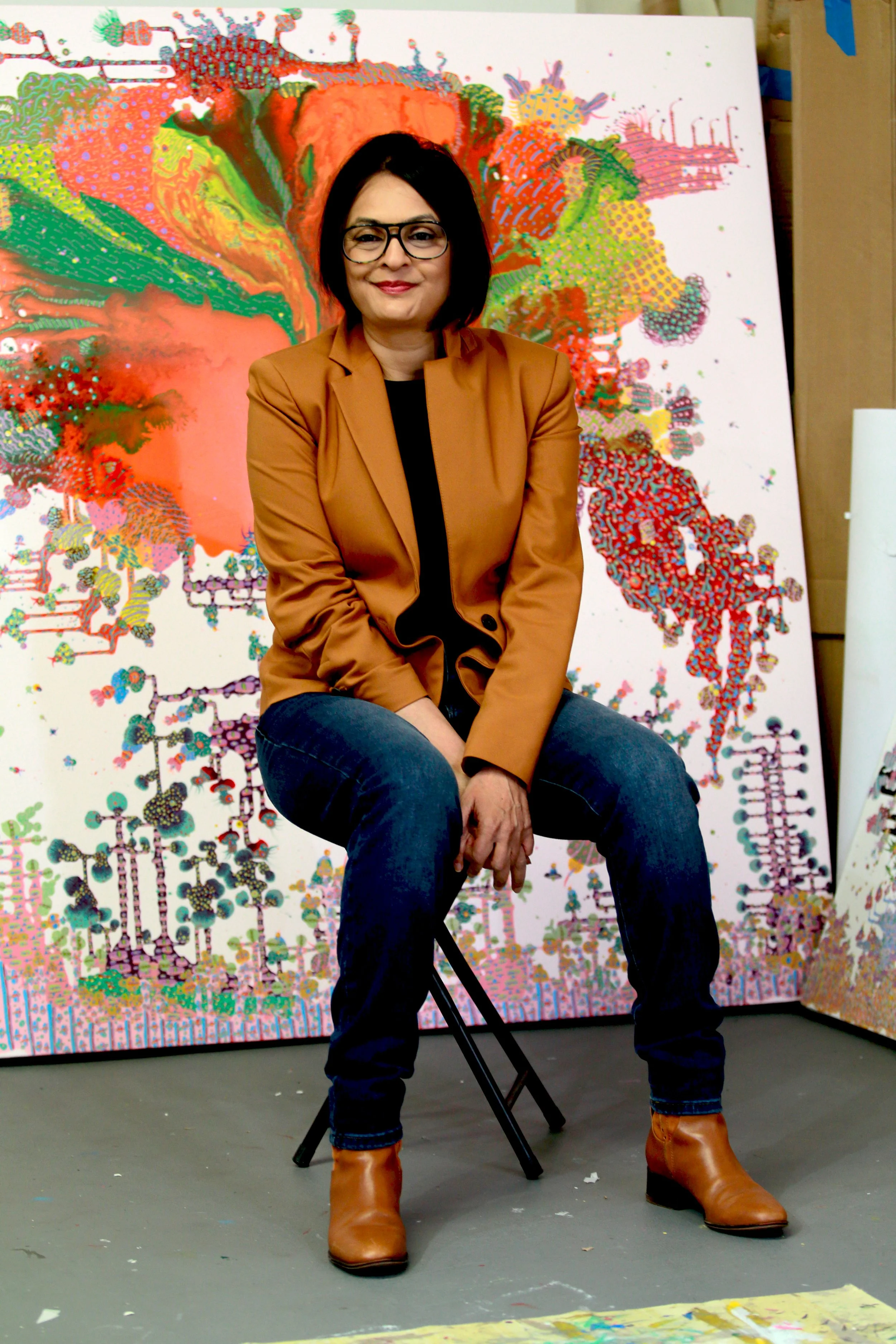
photo credit: Anthony Sclafani
We are happy to welcome New York based artist Avani Patel for this edition of The Creative Altar interview series. Avani immigrated from Mumbai India to the United States when she was 11 years old and has gone onto create a strong voice and a unique style through abstraction that draws equal parts on layering, intuition, dreams and memories of her mother’s garden and father’s farm from her homeland. Her work is bold, dreamy and intuitive, combining delicate, playful details with expressive and emotional areas that suggest a Sublime or stormy quality. In today’s conversation, Avani shares with us her definition of success as an artist ( and spoiler… it’s not external recognition) as well as how she has found strength when other’s have doubted her ability to succeed as an immigrant artist. I hope you enjoy discovering Avani’s practice and intriguing painting. Her contact information, website and instagram can be found at the bottom of the article.
Hi Avani, can you share with our readers, what is your art form and how long have you been practicing?
Hello, my name is Avani Patel, and I am a visual artist working primarily in painting and drawing. My practice also extends into installation, murals, and community-based projects. I have been making art for many years, and over time my work has grown through experimentation with materials, patterns, color, and layered forms inspired by nature, memory, and movement.

Avani Patel, Transition of Nature . 36” x 72” , acrylic and paint marker on canvas, 2024
What’s something that you’ve created that you are proud of or that you consider your biggest accomplishment.
One of my greatest accomplishments is building my life as an artist and staying committed to that path despite challenges. My passion for art has always guided me, allowing me to grow through mistakes and difficult moments. As an Asian American artist, there were times when people doubted my ability to succeed, but my parents were my strongest support system. They encouraged me to keep going and to believe in what I love.
“Moving to New York was not easy at first. I struggled financially and took on various jobs to support myself while continuing to create art.”
Because of them, I learned to focus on the positive and not let negativity define my journey. A major turning point came right after I graduated from Tyler School of Art, when I was hired at Brown University. Shortly after, in 2003, I applied for an art residency in New York and was accepted into the Snug Harbor Cultural Center for a studio space. That opportunity led me to move to New York and fully pursue my dream. That same year, I had my first solo exhibition in Times Square through Chashama, which was an incredibly meaningful milestone.
Moving to New York was not easy at first. I struggled financially and took on various jobs to support myself while continuing to create art. However, my persistence paid off. In 2005, I was selected by the American Embassy to exhibit my work in Panama City for three years.
It was a surreal and deeply meaningful experience being invited as an immigrant artist from India to share my work with new audiences and speak to the community and youth. These experiences shaped me not only as an artist but as a person. They taught me resilience, self-belief, and the importance of continuing forward no matter the obstacles. I am proud of the journey I have created and the life I continue to build through my art.
“It was a surreal and deeply meaningful experience being invited as an immigrant artist from India to share my work with new audiences and speak to the community and youth.”
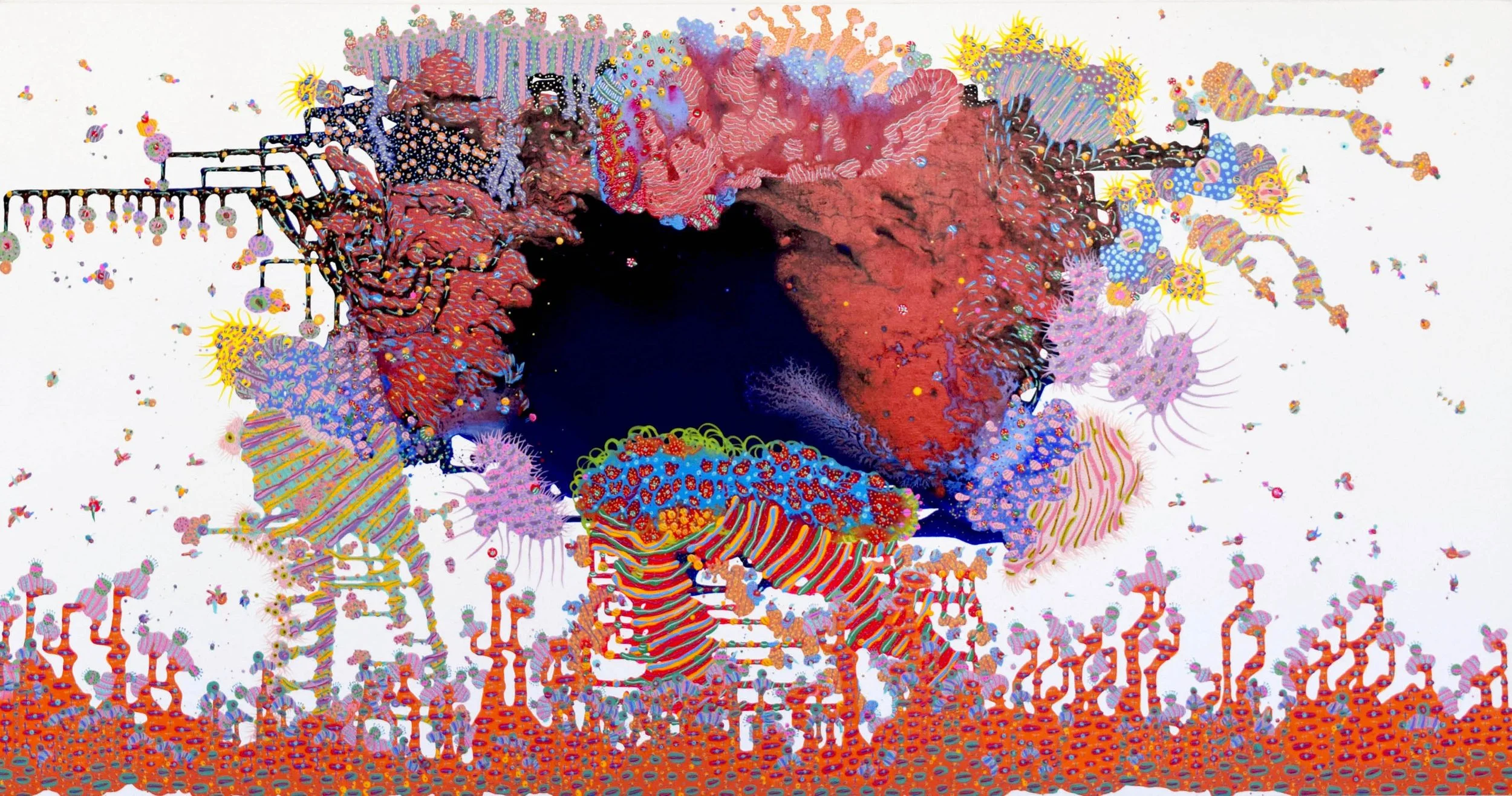
Avani Patel, Nairobi, 32” x 72”, acrylic and paint marker on canvas 2024
How do you define success as an artist?
I define success as an artist not just by recognition or exhibitions, but by the ability to stay curious, keep growing, and remain committed to my practice. For me, success means creating work that feels honest and alive, and that invites others to slow down, reflect, and connect. It also includes building meaningful relationships through community projects, teaching, and collaborations, where art becomes a shared experience rather than something distant.
What is your favorite moment of the creative process?
My favorite moment is when the work starts to surprise me—when layers of marks, color, and patterns begin to come together and unexpected forms emerge. It’s that point where the piece feels alive and starts guiding me instead of the other way around. I really enjoy that sense of discovery, where I’m responding intuitively and the process feels open, playful, and full of possibility.

Avani Patel, Red and White. 7.5x22 in, acrylic and paint marker on paper 2020
How do you access your creativity?
I access my creativity through observation, memory, and experimentation. I spend time noticing patterns in nature, movement, and everyday environments, and I often draw from memories of landscapes, gardens, and lived experiences. My process is very intuitive. I begin with loose marks and allow the work to evolve through layering, repetition, and color.
Do you experiment or take risks in your creative practice?
Experimentation is a big part of my practice. I take risks by trying new materials, shifting scales, and allowing unexpected forms to emerge rather than planning everything in advance. I’m interested in discovery, so I give myself permission to not fully know where the work is going. That openness is what keeps the process alive and continually evolving.

Avani Patel, Purple Running, 7.5” x 22” acrylic and paint marker on paper, 2020
At what stage of the creative process do you notice your inner critic appears or get the loudest?
My inner critic tends to be the loudest in the middle of the process, when the work feels unresolved and uncertain. That’s often the most vulnerable stage, because nothing feels fully formed yet. I’ve learned to recognize that as a natural part of creating rather than a sign that something is wrong. It can also show up after I finish a piece or when I’m preparing to exhibit, especially when I start thinking about how the work will be received. But over time, I’ve learned to quiet that voice by trusting my process and staying focused on why I do the work in the first place: curiosity, exploration, and connection.
What type of things does your inner critic say to you?
My inner critic often asks whether the work is strong enough or if it’s too repetitive, especially since my practice involves patterns and layering. It can say things like, “This isn’t working,” or “You’ve already done this before,” which can create moments of doubt.
What’s the meanest thing has your inner critic ever said to you and how has that affected you in your creative journey?
At its worst, it can make me question my direction or whether I’m pushing myself enough. But I’ve learned to see that voice as part of the process rather than something to stop me. It pushes me to look more closely, take more risks, and refine the work. Over time, I’ve become better at not letting it take over and instead using it as a tool for growth rather than self-doubt.
What coping mechanisms tools or techniques help you deal with your inner critic?
When my inner critic gets loud, I try to step back and give myself a bit of distance from the work. Sometimes that means taking a short break, going for a walk, or shifting to a different piece so I can return with fresh eyes. I also remind myself that uncertainty is a natural part of the process, not a failure. In the past, I’ve noticed that overworking a piece or constantly second-guessing myself can be unhelpful; it can take away the energy and spontaneity from the work.
What’s more supportive is trusting my intuition, working in layers without judging too quickly, and staying connected to why I started the piece in the first place. Teaching and working with communities also helps me stay grounded, because it reminds me that creativity is about exploration and connection, not perfection.
“What’s more supportive is trusting my intuition, working in layers without judging too quickly, and staying connected to why I started the piece in the first place.”

Avani Patel, Roots of the Unknown. 30” x 40” , acyrlic and paint marker on canvas, 2024
Do dreams play a role in your creativity?
Dreams do play a role in my creativity, especially in how I think about imagery, memory, and imagination. I don’t always document my dreams, but I’m very drawn to that in- between space where things feel familiar yet slightly transformed. In many ways, memory itself feels like a kind of dream.
I often think about my mother’s garden and my father’s farm those early experiences stay with me almost like dream landscapes. They reappear in my work through imagined creatures, growing forms, and shifting environments. I’ve also had dreams of moving through these kinds of spaces, where plants expand, colors change, and everything feels alive and in motion. Those impressions influence how I build my work. They remind me to stay intuitive, to trust transformation, and to allow the image to evolve in unexpected ways.
“I often think about my mother’s garden and my father’s farm those early experiences stay with me almost like dream landscapes.”
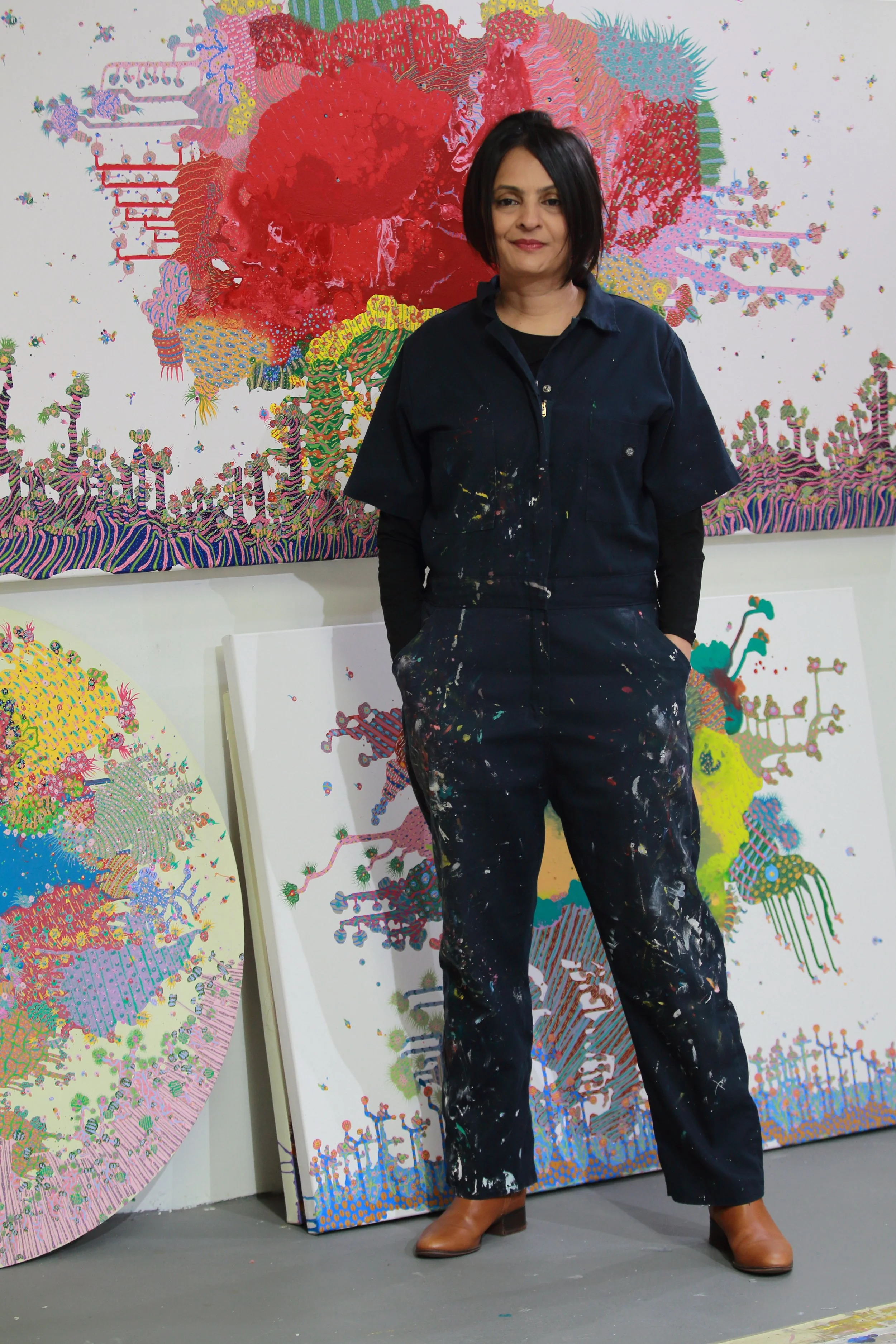
photo credit: Anthony Sclafani
Biography
Born in Mumbai, India, Avani Patel immigrated with her family to Pennsylvania at the age of eleven. She holds a BA from Pennsylvania State University and an MFA from the Tyler School of Art at Temple University. Patel’s paintings have been exhibited widely across the United States and internationally. From 2003 to 2006, her work was shown at the American Embassy’s ambassador residence in Panama, where she also led community workshops and collaborative installations. In 2005, she was invited to the White House by Laura Bush and Colin Powell in recognition of her participation in the U.S. Department of State’s Art in Embassies program. Patel has contributed to significant public art initiatives, including America’s Chinatown Voices in New York City and a public art project in Lillestrøm, Norway. Her work has been reviewed and featured in Hyperallergic, Artnet, and The Woven Tale Press, and is held in private and corporate collections in the United States and abroad. In 2025, she was selected for the ArtBridge and CAMBA Affordable Housing public art project in Brooklyn. Patel lives and works in Brooklyn, New York.
Press
https://hyperallergic.com/10-exhibitions-to-see-in-upstate-new-york-october-2025/
https://www.cambahousingventures.org/artbridge-and-camba-housing-ventures-unveil- 700-foot-long-public-art-exhibition-at-new-passive-house-affordable-and-supportive- housing-development-in-flatbush-brooklyn/
https://whitehotmagazine.com/articles/fishman-nannycam-dena-novak-more/7093
Contact
website www.avanirpatel.com